
Abstract
Autism and autism spectrum disorders (ASDs) are heterogeneous neurodevelopmental disorders. They are enigmatic conditions that have their origins in the interaction of genes and environmental factors. ASDs are characterized by dysfunctions in social interaction and communication skills, in addition to repetitive and stereotypic verbal and nonverbal behaviours. Immune dysfunction has been confirmed with autistic children. There are no defined mechanisms of pathogenesis or curative therapy presently available. Indeed, ASDs are still untreatable. Available treatments for autism can be divided into behavioural, nutritional, and medical approaches, although no defined standard approach exists. Nowadays, stem cell therapy represents the great promise for the future of molecular medicine. Among the stem cell population, mesenchymal stem cells (MSCs) show probably best potential good results in medical research. Due to the particular immune and neural dysregulation observed in ASDs, mesenchymal stem cell transplantation could offer a unique tool to provide better resolution for this disease.
1. Autism Spectrum Disorders
Autism and autism spectrum disorders (ASDs) are heterogeneous neurodevelopmental disorders. They are enigmatic conditions that have their origins in the interaction of genes and environmental factors. ASDs are characterized by dysfunctions in social interaction and communication skills, in addition to repetitive and stereotypic verbal and nonverbal behaviours. Several biochemical events are associated with ASDs: oxidative stress; endoplasmic reticulum stress; decreased methylation capacity; limited production of glutathione; mitochondrial dysfunction; intestinal dysbiosis; increased toxic metal burden; immune dysregulation; immune activation of neuroglial cells. The exact aetiology of ASDs is unknown, likely it results from a complex combination of genetic, environmental, and immunological factors. This heritable disorder derives from genetic variations in multiple genes, making its treatment particularly difficult. Environment (i.e., air pollution, organophosphates, and heavy metals) also contributes to the incidence of ASDs.
Frequency of these disorders is increasing: 56% reported increase in paediatric prevalence between 1991 and 1997 until present rates of about 60 cases per 10,000 children, according to Center for Disease Control. ASDs are increasingly being recognized as a public health problem. Pathophysiology and defined mechanisms of pathogenesis of autism remain still unclear. There are no drugs effective for treatment of core symptoms of ASDs. Indeed, ASDs are still untreatable. Current available treatments for autism can be divided into behavioural, nutritional, and pharmacological options, in addition to individual and family psychotherapy and other nonpharmacologic interventions. However, no defined standard approach exists. Pharmacological approaches are direct towards neuropsychiatric disorders coassociated with ASDs. Psycho-stimulants, alpha-2 agonists, beta blockers, lithium, anticonvulsant mood stabilizers, atypical antipsychotics, traditional antipsychotics, selective serotonin reuptake inhibitors, antidepressants, and antipsychotics, are drugs commonly prescribed. Catatonia is treated with lorazepam and bilateral electroconvulsive therapy. Selective serotonin reuptake inhibitors are prescribed for the treatment of depression, anxiety, and obsessive-compulsive ASD-associated behaviours.
Other nonpsychotropic drugs which are supported by at least 1 or 2 prospective randomized controlled trials or 1 systematic review include melatonin, acetylcholinesterase inhibitors, naltrexone, carnitine, tetrahydrobiopterin, vitamin C, hyperbaric oxygen treatment, immunomodulation and anti-inflammatory treatments, oxytocin, and even music therapy and vision therapy.
Alternative and complementary treatments, not sufficiently supported by medical literature, include herbal remedies, vitamin and mineral therapies, piracetam, elimination diets, chelation, cyproheptadine, famotidine, glutamate antagonists, special dietary supplements, acupuncture, neurofeedback, and sensory integration training. On the other hand, behavioural treatment could represent the effective intervention strategy for autism. A plethora of behavioural strategies and social skill trainings have been used. However, it has been demonstrated that no definitive behavioural intervention completely improves all symptoms for all ASD patients.
Summarizing, all these therapies indicate that further research is needed to better address treatment of several medical conditions experienced by ASD patients.
2. Mesenchymal Stem Cells
Nowadays, stem cell therapy represents the great promise for the future of molecular medicine. The progression of several diseases can be slowed or even blocked by stem cell transplantation.
Among the stem cell population, mesenchymal stem cells (MSCs) show probably best potential good results in medical research. These cells are nonhematopoietic stem cells having a multilineage potential, as they have the capacity of differentiating into both mesenchymal and nonmesenchymal lineages. MSCs are a population of progenitor cells of mesodermal origin found principally in the bone marrow of adults, giving rise to skeletal muscle cells, blood, fat, vascular, and urogenital systems, and to connective tissues throughout the body. According to the International Society of Cellular Therapy, MSCs are defined by the following minimal set of criteria: (1) grown in adherence to plastic surface of dishes when maintained in standard culture conditions; (2) express cytospecific cell surface markers, that is, CD105, CD90, and CD73, to be negative for other cell surface markers, that is, CD45, CD34, CD14, and CD11b; (3) possess the capacity to differentiate into mesenchymal lineages, under appropriate in vitro conditions. MSCs can be isolated from different tissues other than bone marrow: adipose tissue, liver, tendons, synovial membrane, amniotic fluid, placenta, umbilical cord, and teeth. MSCs show a high expansion potential, genetic stability, stable phenotype, high proliferation rate as adherent cells, and self-renew capacity and can be easily collected and shipped from the laboratory to the bedside and are compatible with different delivery methods and formulations. In addition, MSCs have two other extraordinary properties: they are able to migrate to sites of tissue injury, where they are able to inhibit the release of proinflammatory cytokines and have strong immunosuppressive activity that renders them a useful tool for successful autologous, as well as heterologous, transplantations without requiring pharmacological immunosuppression. Besides, MSCs are easily isolated from a small aspirate of bone marrow and expanded with high efficiency. Given that MSCs are multipotent cells with a number of potential therapeutic applications, and they represent a future powerful tool in regenerative medicine, including ASDs. Mesenchymal stem cells could be transplanted directly without genetic modification or pretreatments. They simply eventually differentiate according to cues from the surrounding tissues and do not give uncontrollable growth or tumours. In clinical application, there is no problem with immune rejection because of their in vivo immunosuppressive properties. In addition, MSCs can readily be isolated from the patients requiring transplant or from their parents. There is also no tumour formation on transplantation. No moral objection or ethical controversies are involved.
In principle, mesenchymal stem cells can act through several possible mechanisms, that is, stimulating the plastic response in the host damaged tissue, secreting survival-promoting growth factors, restoring synaptic transmitter release by providing local reinnervations, integrating into existing neural and synaptic network, and reestablishing functional afferent and efferent connections. Since MSCs have the capability to produce a large array of trophic and growth factors both in vivo and in vitro. (MSCs constitutively secrete interleukins (IL)-6, IL-7, IL-8, IL-11, IL-12, IL-14, IL-15, macrophage colony-stimulating factor, Flt-3 ligand, and stem-cell factor). A more reasonable explanation for the functional benefit derived from MSC transplantation is their paracrine activity, by which these cells are able to produce factors that activate endogenous restorative mechanisms within injured tissues contributing to recovery of function lost as a result of lesions.
3. Autism, Personalized Therapy through Mesenchymal Stem Cells
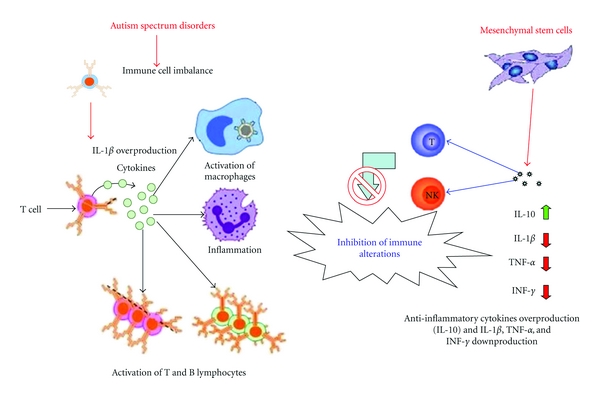
MSCs have a strong long-lasting immunosuppressive capacity. This extraordinary property is mediated via soluble factors. MSCs are able to inhibit the proliferation of CD8+ and CD4+ T lymphocytes and natural killer (NK) cells, to suppress the immunoglobulin production by plasma cells, to inhibit the maturation of dendritic cells (DCs) and the proliferation of regulatory T cells. It has been demonstrated that MSCs are also able to inhibit T lymphocyte pro-inflammatory cytokine production in vitro, as well as in vivo. Their ability to modulate the immune system opens a wide range of cell-mediated applications, not only for autoimmune diseases and graft-versus-host disease. Due to the particular immune system dysregulation observed in ASDs, mesenchymal stem cell transplantation could offer a unique tool to provide better resolution for this disease. Indeed, in ASDs pathogenesis, innate and adaptive immunity changes have been reported. ASD patients show an imbalance in CD3+, CD4+, and CD8+ T cells, as well as in NK cells. In addition, peripheral blood mononuclear cells (PBMCs) extracted from ASD patients are able to overproduce IL-1β resulting in long-term immune alterations. MSC-mediated immune suppressive activity could restore this immune imbalance (Figure 1). Indeed, MSC immunoregulatory effects strongly inhibit T-cell recognition and expansion by inhibiting TNF-α and INF-γ production and increasing IL-10 levels.
It has been demonstrated that in postmortem brains from ASD patients there is evidence of abnormal functioning and cerebellum alterations. Indeed, ASD subjects show a decreased number of Purkinje cells in the cerebellum. These changes could reflect defective cortical organization in ASDs development. In addition, autism is associated with dysregulation in the maturation and plasticity of dendritic spine morphology. Restoring injured brain functioning could be achieved by stem-cell-based cell replacement. Indeed, transplanted MSCs are able to promote synaptic plasticity and functional recovery and rescue cerebellar Purkinje cells. Challenging newest study from Deng et al. suggests that granulocyte colony-stimulating factor (G-CSF) is able to mobilize MSCs into peripheral blood. These mobilized MSCs are incorporated and integrate into damaged brain in craniocerebral injured mice, ameliorating the effect of trauma. It is noteworthy that MSC ability to migrate to the sites of injury and participate in the repair process is a key issue in tissue repair. Also by this way, MSC therapy could restore the altered brain organization seen in autistic subjects (Table 1).
A key dilemma in stem-cell-based therapy for autism treatment is whether endogenous or exogenous MSC administration is the best way of stem cell delivery. Endogenous strategy could be limited by the availability of MSCs. Exogenous MSCs could show low rate of engraftment to provide cellular replacement. It is unclear if differentiated cells are able to develop functional interconnections with the intrinsic cells of the recipient host. Controversy, few exogenous MSCs are able to exert paracrine activity. Indeed, exogenously applied MSCs have been shown to home to injured tissues and repair them by producing chemokines, or by cell or nuclear fusion with host cells. On the other hand, exogenous culture-expanded MSCs could address endogenous MSCs in order to activate them and guide intrinsic repair. In addition, exogenous delivery bypasses surgical intervention on the autistic child.
Cellular therapy could represent a new frontier in the treatment of several diseases. Despite the fact that MSCs have been enrolled in several clinical trials, long-term safety of MSC-based therapies is not yet well established; this fact could be one major limitation to clinical translation. At the present, there are no preclinical studies on the use of MSCs in ASD models. There is just one clinical trial (NCT01343511 http://www.clinicaltrial.gov/) concerning the safety and efficacy of human umbilical cord mesenchymal stem cells (hUC-MSCs) and human cord blood mononuclear cells (hCB-MNCs) transplantation in patients with autism by Shenzhen Beike Bio-Technology Co., China. Results are not yet posted.
However, personalized stem cell therapy will be the most effective treatment for a specific autistic child, opening a new era in autism management in the next future.
Figures and tables
| ASD-induced changes in human brain | Potential MSC ameliorative roles seen in preclinical models |
|---|---|
| Abnormal functioning | Improving functional recovery |
| Cerebellum alterations | Integrating in altered brain and restoring damaged functions |
| Decreased number of Purkinje cells (PCs) | Restoring cerebellar PCs |
| Defective cortical organization | Reinforcing cortical plasticity |
| Altered plasticity of dendritic spine morphology | Promoting synaptic plasticity |
Sources
- Fasano ALyndhurst NJIntestine, leaky gut, autism and probioticsCutting Edge Therapies2010Barnes & Noble192198
- Williams K, Wheeler DM, Silove N, Hazell PSelective serotonin reuptake inhibitors (SSRIs) for autism spectrum disorders (ASD)Cochrane Database of Systematic Reviews20108Article ID CD004677. https://doi.org/10.1002/14651858.CD004677.pub2
- Toro R, Konyukh M, Delorme RKey role for gene dosage and synaptic homeostasis in autism spectrum disordersTrends in Genetics2010268363372 https://doi.org/10.1016/j.tig.2010.05.007
- Bradstreet JJ, Smith S, Baral M, Rossignol DABiomarker-guided interventions of clinically relevant conditions associated with autism spectrum disorders and attention deficit hyperactivity disorderAlternative Medicine Review20101511532 https://pubmed.ncbi.nlm.nih.gov/20359266/
- Persico AM, Bourgeron TSearching for ways out of the autism maze: genetic, epigenetic and environmental cluesTrends in Neurosciences2006297349358 https://doi.org/10.1016/j.tins.2006.05.010
- Toro R, Konyukh M, Delorme RKey role for gene dosage and synaptic homeostasis in autism spectrum disordersTrends in Genetics2010268363372 https://doi.org/10.1016/j.tig.2010.05.007
- El-Fishawy P, State MWThe genetics of autism: key issues, recent findings, and clinical implicationsPsychiatric Clinics of North America201033183105 https://doi.org/10.1016/j.psc.2009.12.002
- Herbert MRContributions of the environment and environmentally vulnerable physiology to autism spectrum disordersCurrent Opinion in Neurology2010232103110 https://doi.org/10.1097/WCO.0b013e328336a01f
- Muhle R, Trentacoste SV, Rapin IThe genetics of autismPediatrics20041135e472e486 https://doi.org/10.1542/peds.113.5.e472
- Levy SE, Mandell DS, Schultz RTAutismThe Lancet2009374970116271638 https://doi.org/10.1016/S0140-6736(09)61376-3
- CDCSurveillance summariesMorbidity and Mortality Weekly Report200756128 https://pubmed.ncbi.nlm.nih.gov/7476848/
- Main PA, Angley MT, Thomas P, O’Doherty CE, Fenech MFolate and methionine metabolism in autism: a systematic reviewAmerican Journal of Clinical Nutrition201091615981620 https://doi.org/10.3945/ajcn.2009.29002
- Reiersen AM, Todd RDCo-occurrence of ADHD and autism spectrum disorders: phenomenology and treatmentExpert Review of Neurotherapeutics200884657669 https://doi.org/10.1586/14737175.8.4.657
- McCracken JTSafety issues with drug therapies for autism spectrum disordersJournal of Clinical Psychiatry200566supplement 103237 https://pubmed.ncbi.nlm.nih.gov/16401148/
- Tandon M, Pruett JRAn overview of the use of antidepressants in children and adolescentsMissouri Medicine200810517985 https://pubmed.ncbi.nlm.nih.gov/18300611/
- Nevels RM, Dehon EE, Alexander K, Gontkovsky STPsychopharmacology of aggression in children and adolescents with primary neuropsychiatric disorders: a review of current and potentially promising treatment optionsExperimental and Clinical Psychopharmacology2010182184201 https://doi.org/10.1037/a0018059
- Dhossche DM, Shah A, Wing LBlueprints for the assessment, treatment, and future study of catatonia in autism spectrum disordersInternational Review of Neurobiology200672267284 https://doi.org/10.1016/S0074-7742(05)72016-X
- Rossignol DANovel and emerging treatments for autism spectrum disorders: a systematic reviewAnnals of Clinical Psychiatry2009214213236 https://pubmed.ncbi.nlm.nih.gov/19917212/
- Şenel HGParents’ views and experiences about complementary and alternative medicine treatments for their children with autistic spectrum disorderJournal of Autism and Developmental Disorders2010404494503 https://doi.org/10.1007/s10803-009-0891-4
- Wong VC, Sun JGRandomized controlled trial of acupuncture versus sham acupuncture in autism spectrum disorderJournal of Alternative and Complementary Medicine2010165545553 https://doi.org/10.1089/acm.2007.0768
- Filipek PA, Steinberg-Epstein R, Book TMIntervention for autistic spectrum disordersNeuroRx200632207216 https://doi.org/10.1016/j.nurx.2006.01.014
- Vismara LA, Rogers SJBehavioral treatments in autism spectrum disorder: what do we know?Annual Review of Clinical Psychology20106447468 https://doi.org/10.1146/annurev.clinpsy.121208.131151
- Kasari C, Lawton KNew directions in behavioral treatment of autism spectrum disordersCurrent Opinion in Neurology2010232137143 https://doi.org/10.1097/WCO.0b013e32833775cd
- Murdock LC, Hobbs JQPicture me playing: increasing pretend play dialogue of children with autism spectrum disordersJournal of Autism and Developmental Disorders201141870878 https://doi.org/10.1007/s10803-010-1108-6
- Frankel F, Whitham CParent-assisted group treatment for friendship problems of children with autism spectrum disordersBrain Research20111380240245 https://doi.org/10.1016/j.brainres.2010.09.047
- Valenti M, Cerbo R, Masedu F, De Caris M, Sorge GIntensive intervention for children and adolescents with autism in a community setting in Italy: a single-group longitudinal studyChild and Adolescent Psychiatry and Mental Health20104, article no. 23 https://doi.org/10.1186/1753-2000-4-23
- Ospina MB, Seida JK, Clark BBehavioural and developmental interventions for autism spectrum disorder: a clinical systematic reviewPLoS One2008311Article ID e3755. https://doi.org/10.1371/journal.pone.0003755
- Stahmer AC, Schreibman L, Cunningham ABToward a technology of treatment individualization for young children with autism spectrum disordersBrain Research20111380229239 https://doi.org/10.1016/j.brainres.2010.09.043
- Coury DMedical treatment of autism spectrum disordersCurrent Opinion in Neurology2010232131136 https://doi.org/10.1097/WCO.0b013e32833722fa
- Siniscalco D, Sullo N, Maione S, Rossi F, D’Agostino BStem cell therapy: the great promise in lung diseaseTherapeutic Advances in Respiratory Disease200823173177 https://doi.org/10.1177/1753465808092340
- Brooke G, Cook M, Blair CTherapeutic applications of mesenchymal stromal cellsSeminars in Cell and Developmental Biology2007186846858 https://doi.org/10.1016/j.semcdb.2007.09.012
- Arthur A, Zannettino A, Gronthos SThe therapeutic applications of multipotential mesenchymal/stromal stem cells in skeletal tissue repairJournal of Cellular Physiology20092182237245 https://doi.org/10.1002/jcp.21592
- Chagastelles PC, Nardi NB, Camassola MBiology and applications of mesenchymal stem cellsScience Progress2010932113127 https://doi.org/10.3184/003685010X12708175591515
- Short B, Brouard N, Occhiodoro-Scott T, Ramakrishnan A, Simmons PJMesenchymal stem cellsArchives of Medical Research2003346565571 https://doi.org/10.1016/j.arcmed.2003.09.007
- Beyer Nardi N, da Silva Meirelles LMesenchymal stem cells: isolation, in vitro expansion and characterizationHandbook of Experimental Pharmacology2006174249282 https://pubmed.ncbi.nlm.nih.gov/16370331/
- Sethe S, Scutt A, Stolzing AAging of mesenchymal stem cellsAgeing Research Reviews20065191116 https://doi.org/10.1016/j.arr.2005.10.001
- Dominici M, Le Blanc K, Mueller IMinimal criteria for defining multipotent mesenchymal stromal cells. The International Society for Cellular Therapy position statementCytotherapy200684315317 https://doi.org/10.1080/14653240600855905
- Giordano A, Galderisi U, Marino IRFrom the laboratory bench to the patient’s bedside: an update on clinical trials with mesenchymal stem cellsJournal of Cellular Physiology200721112735 https://doi.org/10.1002/jcp.20959
- Pricola KL, Kuhn NZ, Haleem-Smith H, Song Y, Tuan RSInterleukin-6 maintains bone marrow-derived mesenchymal stem cell stemness by an ERK1/2-dependent mechanismJournal of Cellular Biochemistry20091083577588 https://doi.org/10.1002/jcb.22289
- Le Blanc K, Pittenger MFMesenchymal stem cells: progress toward promiseCytotherapy2005713645 https://doi.org/10.1080/14653240510018118
- Beggs KJ, Lyubimov A, Borneman JNImmunologic consequences of multiple, high-dose administration of allogeneic mesenchymal stem cells to baboonsCell Transplantation2006158-9711721 https://doi.org/10.3727/000000006783981503
- Uccelli A, Moretta L, Pistoia VMesenchymal stem cells in health and diseaseNature Reviews Immunology200889726736 https://doi.org/10.1038/nri2395
- Aronin CEP, Tuan RSTherapeutic potential of the immunomodulatory activities of adult mesenchymal stem cellsBirth Defects Research Part C Embryo Today20109016774 https://doi.org/10.1002/bdrc.20174
- Siniscalco DTransplantation of human mesenchymal stem cells in the study of neuropathic painMethods in Molecular Biology2010617337345 https://doi.org/10.1007/978-1-60327-323-7_25
- Sotiropoulou PA, Papamichail MImmune properties of mesenchymal stem cellsMethods in Molecular Biology2007407225243 https://doi.org/10.1007/978-1-59745-536-7_16
- Newman RE, Yoo D, LeRoux MA, Danilkovitch-Miagkova ATreatment of inflammatory diseases with mesenchymal stem cellsInflammation and Allergy200982110123 https://doi.org/10.2174/187152809788462635
- Meyerrose T, Olson S, Pontow SMesenchymal stem cells for the sustained in vivo delivery of bioactive factorsAdvanced Drug Delivery Reviews2010621211671174 https://doi.org/10.1016/j.addr.2010.09.013
- Ksiazek KA comprehensive review on mesenchymal stem cell growth and senescenceRejuvenation Research2009122105116 https://doi.org/10.1089/rej.2009.0830
- Siniscalco D, Giordano C, Galderisi UIntra-brain microinjection of human mesenchymal stem cells decreases allodynia in neuropathic miceCellular and Molecular Life Sciences2010674655669 https://doi.org/10.1007/s00018-009-0202-4
- Majumdar MK, Thiede MA, Mosca JD, Moorman M, Gerson SLPhenotypic and functional comparison of cultures of marrow-derived mesenchymal stem cells (MSCs) and stromal cellsJournal of Cellular Physiology199817615766 https://doi.org/10.1002/(SICI)1097-4652(199807)176:1<57::AID-JCP7>3.0.CO;2-7
- da Silva Meirelles L, Fontes AM, Covas DT, Caplan AIMechanisms involved in the therapeutic properties of mesenchymal stem cellsCytokine and Growth Factor Reviews2009205-6419427 https://doi.org/10.1016/j.cytogfr.2009.10.002
- Giuliani M, Fleury M, Vernochet ALong-lasting inhibitory effects of fetal liver mesenchymal stem cells on T-lymphocyte proliferationPLoS One201165Article ID e19988. https://doi.org/10.1371/journal.pone.0019988
- Hoogduijn MJ, Popp F, Verbeek RThe immunomodulatory properties of mesenchymal stem cells and their use for immunotherapyInternational Immunopharmacology2010101214961500 https://doi.org/10.1016/j.intimp.2010.06.019
- Nicola MD, Carlo-Stella C, Magni MHuman bone marrow stromal cells suppress T-lymphocyte proliferation induced by cellular or nonspecific mitogenic stimuliBlood2002991038383843 https://doi.org/10.1182/blood.v99.10.3838
- Beyth S, Borovsky Z, Mevorach DHuman mesenchymal stem cells alter antigen-presenting cell maturation and induce T-cell unresponsivenessBlood2005105522142219 https://doi.org/10.1182/blood-2004-07-2921
- Dazzi F, Marelli-Berg FMMesenchymal stem cells for graft-versus-host disease: close encounters with T cellsEuropean Journal of Immunology200838614791482 https://doi.org/10.1002/eji.200838433
- Ashwood P, Corbett BA, Kantor A, Schulman H, Van de Water J, Amaral DGIn search of cellular immunophenotypes in the blood of children with autismPLoS One201165Article ID e19299. https://doi.org/10.1371/journal.pone.0019299
- Suzuki K, Matsuzaki H, Iwata KPlasma cytokine profiles in subjects with high-functioning autism spectrum disordersPLoS One201165Article ID e20470. https://doi.org/10.1371/journal.pone.0020470
- Gupta S, Samra D, Agrawal SAdaptive and innate immune responses in autism: rationale for therapeutic use of intravenous immunoglobulinJournal of Clinical Immunology201030supplement 1S90S96 https://doi.org/10.1007/s10875-010-9402-9
- Enstrom AM, Onore CE, Van de Water JA, Ashwood PDifferential monocyte responses to TLR ligands in children with autism spectrum disordersBrain, Behavior, and Immunity20102416471 https://doi.org/10.1016/j.bbi.2009.08.001
- Oblak AL, Rosene DL, Kemper TL, Bauman ML, Blatt GJAltered posterior cingulate cortical cyctoarchitecture, but normal density of neurons and interneurons in the posterior cingulate cortex and fusiform gyrus in autismAutism Research20114200211 https://doi.org/10.1002/aur.188
- Whitney ER, Kemper TL, Rosene DL, Bauman ML, Blatt GJDensity of cerebellar basket and stellate cells in autism: evidence for a late developmental loss of Purkinje cellsJournal of Neuroscience Research2009871022452254 https://doi.org/10.1002/jnr.22056
- Courchesne E, Karns CM, Davis HRUnusual brain growth patterns in early life in patients with autistic disorder: an MRI studyNeurology2001572245254 https://doi.org/10.1212/wnl.57.2.245
- Bauman ML, Kemper TLNeuroanatomic observations of the brain in autism: a review and future directionsInternational Journal of Developmental Neuroscience2005232-3183187 https://doi.org/10.1016/j.ijdevneu.2004.09.006
- Fortin DA, Srivastava T, Soderling TRStructural modulation of dendritic spines during synaptic plasticityNeuroscientist. In press https://doi.org/10.1177/1073858411407206
- Sørensen AT, Rogelius N, Lundberg C, Kokaia MActivity-dependent long-term plasticity of afferent synapses on grafted stem/progenitor cell-derived neuronsExperimental Neurology20112292274281 https://doi.org/10.1016/j.expneurol.2011.02.008
- Rodrigues Hell RC, Silva Costa MM, Goes AM, Oliveira ALLocal injection of BDNF producing mesenchymal stem cells increases neuronal survival and synaptic stability following ventral root avulsionNeurobiology of Disease2009332290300 https://doi.org/10.1016/j.nbd.2008.10.017
- Chang YK, Chen MH, Chiang YHMesenchymal stem cell transplantation ameliorates motor function deterioration of spinocerebellar ataxia by rescuing cerebellar Purkinje cellsJournal of Biomedical Science201118, article 541 https://doi.org/10.1186/1423-0127-18-54
- Deng J, Zou ZM, Zhou TLBone marrow mesenchymal stem cells can be mobilized into peripheral blood by G-CSF in vivo and integrate into traumatically injured cerebral tissueNeurological Sciences2011324641651 https://doi.org/10.1007/s10072-011-0608-2
- Li L, Jiang JRegulatory factors of mesenchymal stem cell migration into injured tissues and their signal transduction mechanismsFrontier Medical201153339 https://doi.org/10.1007/s11684-011-0114-1
- Prockop DJ, Gregory CA, Spees JLOne strategy for cell and gene therapy: harnessing the power of adult stem cells to repair tissuesProceedings of the National Academy of Sciences of the United States of America200310011191711923 https://doi.org/10.1073/pnas.1834138100
- Augello A, Kurth TB, De Bari CMesenchymal stem cells: a perspective from in vitro cultures to in vivo migration and nichesEuropean Cells and Materials201020121133 https://doi.org/10.22203/ecm.v020a11
- Momin EN, Mohyeldin A, Zaidi HA, Vela G, Quiñones-Hinojosa AMesenchymal stem cells: new approaches for the treatment of neurological diseasesCurrent Stem Cell Research and Therapy201054326344 https://doi.org/10.2174/157488810793351631