
Abstract
In recent years, a large number of studies have contributed to our understanding of the immunomodulatory mechanisms used by multipotent mesenchymal stem cells (MSCs). Initially isolated from the bone marrow (BM), MSCs have been found in many tissues but the strong immunomodulatory properties are best studied in BM MSCs. The immunomodulatory effects of BM MSCs are wide, extending to T lymphocytes and dendritic cells, and are therapeutically useful for treatment of immune-related diseases including graft-versus-host disease as well as possibly autoimmune diseases. However, BM MSCs are very rare cells and require an invasive procedure for procurement. Recently, MSCs have also been found in fetal-stage embryo-proper and extra-embryonic tissues, and these human fetal MSCs (F-MSCs) have a higher proliferative profile, and are capable of multilineage differentiation as well as exert strong immunomodulatory effects. As such, these F-MSCs can be viewed as alternative sources of MSCs. We review here the current understanding of the mechanisms behind the immunomodulatory properties of BM MSCs and F-MSCs. An increase in our understanding of MSC suppressor mechanisms will offer insights for prevalent clinical use of these versatile adult stem cells in the near future.
1. Mesenchymal stem cells: Definition and functional capacity
Human mesenchymal stem cells (MSCs) are a population of multilineage progenitor cells with the ability to differentiate into multiple mesenchymal lineages such as chondrocytes, osteoblasts, or adipocytes. The initial isolation of MSCs was from the bone marrow (BM) based on plastic adherence of the cells as opposed BM hematopoieitic cells which can be cultured in suspension. Increasingly, MSCs have been reported to be isolated from a number of other organs in the adult and fetal-stage tissue. Due to the difficulty in comparing the various methods used to isolate BM and tissue MSCs, a recent movement to define these progenitor cells have proposed a minimal criteria for MSCs in terms of trilineage mesodermal differentiation capacity and expression of a specific panel of cell surface marker including being positive for CD73, CD90, and CD105; and negative for hematopoietic markers such as CD14 or CD11b, CD34, CD45, and CD19 or CD79a. The ease of isolation of MSCs along with reports of differentiation into extra-mesodermal cell types has made MSCs a popular choice for cell therapy for pre-clinical and clinical trials of a variety of diseases.
2. Immunomodulatory Properties of Adult and Fetal-stage MSCs
One important reason for the abundant number of clinical studies using adult BMMSCs is the immunomodulatory properties of these cells. As with organ transplantation, a critical issue in stem cell therapy is the rejection resulting from immune incompatibility between donor and recipient. BMMSCs' immunomodulatory properties appear to obviate this major obstacle for cell therapy; moreover, these immunosuppressive effects allow for an even wider range of disease indications for these progenitor cells, including use for immune-related diseases. BMMSCs appear to be poorly immunogenic, since they constitutively express low levels of major histocompatibility complex (MHC) class I molecules and no MHC class II molecules. Moreover, BMMSCs do not express co-stimulatory molecules such as CD40, CD80, or CD86 which are involved in the activation of T cell for transplant rejection. Several studies show that differentiated and undifferentiated BMMSCs have suppressive effects on alloantigen- and mitogen-stimulated lymphocyte proliferation in in vitro studies using mixed lymphocyte reactions (MLR), with a concomitant reduction in the production of proinflammatory cytokines such as interferon-γ (IFN-γ) and tumor necrosis factor-α (TNF-α). Thus, the clinical indications for human BMMSCs are considerably wider than other human stem cells, ranging from cell replacement for degenerative diseases--common indications for stem cell therapy--as well as immune-related diseases including autoimmune diseases and transplantation rejection.
While the differentiation plasticity and immunomodulatory properties of adult BMMSCs have brought much excitement in terms of prevalent clinical use for these progenitor cells, the fact remains that these cells are very rare, with cell numbers and proliferative capacity further decreasing with age. In addition, an invasive procedure in terms of BM aspiration is needed to obtain BMMSCs. Thus, investigators have worked to identify other abundant and easily attainable sources of MSCs for therapeutic use. While many other adult tissues appear to harbor MSCs as well, the problems of requiring invasive procedures to obtain these relatively rare cells remain. A number of labs have thus turned to using discarded post-partum fetal-stage tissue for isolation of progenitor cells, since fetal umbilical cord blood is known to be a good source for the hematopoietic stem cell, one type of highly used stem cells. Known to be important in mediating the fetomaternal tolerance of pregnancy, fetal-stage extra-embryonic tissues are easily accessible sources for isolation of cells since these tissues are discarded at birth, obviating ethical issues as well.
Fetal MSCs (F-MSCs) have been derived from a number of fetal tissues, including fetal liver and bone marrow. Moreover, extra-embryonic structures of fetal origin are also good sources for MSCs since they are discarded after birth, and MSCs isolated from human umbilical cord blood (UCB)(hUCB-MSCs), the Wharton's Jelly (hWJ-MSCs) of the umbilical cord itself, amniotic fluid (AF)(hAF-MSCs), amnion (hA-MSCs), and the placenta (hP-MSCs) have been demonstrated. These increasing reports on the isolation of MSCs from all these fetal-stage tissues demonstrate that F-MSCs can be an abundant and viable source of MSCs.
In addition to multilineage differentiation capacity, F-MSCs have been demonstrated to harbor strong immunomodulatory effects as well. F-MSCs lack or exhibit very low expression of highly polymorphic MHC class I (HLA-A, HLA-B, and HLA-C); furthermore, they do not express surface MHC class II molecules (HLA-DP, HLA-DQ, and HLA-DR) nor co-stimulatory molecules, such as CD40, CD40 ligand, CD80, and CD86. F-MSCs not only fail to induce an allogeneic or xenogeneic immune response in MLR, but also strongly suppress lymphocyte proliferation induced by mitogens or alloantigens, often in a dose-dependent manner. Based on these data, F-MSCs appear to be as least as non-immunogenic as BMMSCs, and in some reports, appear to be even more immunomodulatory than its adult counterpart. This is supported by clinical experience in hematopoietic stem cell transplantation (HSCT), where lower incidences of immune-related consequences are consistently seen after UCB HSCT compared to BM HSCT.
Based on the accumulating data, it appears that both adult-source MSCs--most prominently BMMSCS--and F-MSCs are good candidates for cell therapy for immune-related diseases in addition to degenerative diseases. In general, the overwhelming majority of the data is based on studies with BMMSCs rather than F-MSCs, since F-MSCs are newer sources of MSCs and have been studied only in the past few years. This review focuses on evidence for the immunomodulation of adult BMMSCs and F-MSCs, properties which appear increasingly relevant for clinical use. Interactions of BMMSCs and F-MSCs with subpopulations of leukocytes, and mechanisms of actions--when investigated--are reviewed.
3. Interactions of human BMMSCs and F-MSCs with leukocyte subpopulations
3.1 Interactions with T Lymphocytes
Currently, the interactions of MSCs with T lymphocytes are the best studied. Many reports have shown that BMMSCs affect several properties of T cells, most prominently efficiently suppressing activated CD4+ T helper cell and CD8+ cytotoxic T cell (CTL) proliferation. Activated T cells are arrested by BMMSCs in the G0/G1 phase of the cell cycle, but apoptosis is not induced. Besides their ability to impair the proliferation of activated T cells, BMMSCs can prolong the survival of unstimulated T cells by rescuing the lymphocytes from activation-induced cell death by down-regulation of Fas receptor and Fas ligand on T cells and inhibition of endogenous proteases involved in cell death. Further studies have shown that BMMSCs reduce IFN-γ production by CD4+ Th1 cells and interleukin (IL)-17 release by CD4+ Th17 lymphocytes, whereas IL-4 secretion by CD4+ Th2 cells is augmented. The cytolytic potential of CTLs can also be efficiently impaired by BMMSCs. Recently, several studies investigated the impact of BMMSCs on T regulatory lymphocytes (Tregs), a population of CD4+ CD25high cells which play an important role in the induction of peripheral tolerance and the inhibition of proinflammatory immune responses. Many studies have shown that BMMSCs cultured with stimulated peripheral blood mononuclear cells (PBMCs) can induce the expansion of functional CD4+ CD25high Foxp3+ Tregs. A number of mechanisms have been suggested--both cell-contact dependent and independent mechanisms--but there is no clear consensus as of yet; for example, transforming growth factor-β (TGF-β) has been cited as being involved in one study but not in another study. This discrepancy may be due to the subtle phenotypic variations induced in BMMSCs by the many methods available for isolation of these adult stem cells.
Several studies have attempted to delineate which specific molecules are involved in the immunomodulatory effect of BMMSCs on T-cell proliferation and effector functions. In the human system, the effects of BMMSCs on T cells are mainly mediated through cell-contact independent processes, implicating the importance of secreted factors. These molecules include IL-1β, TGF-β1, hepatocyte growth factor (HGF), prostaglandin E2 (PGE2), indoleamine 2,3-dioxygenase (IDO), heme oxygenase-1 (HO-1), leukemia inhibitory factor (LIF), insulin-like growth factor (IGF), soluble human leukocyte antigen G5 (sHLA-G5), galectin, and Jagged-1. Most of the inhibitory soluble factors are not constitutively secreted, but can be induced by the interaction between activated effector cells and BMMSCs (Table 1).
| Leukocyte | Effects | Soluble Factors | References |
|---|---|---|---|
| T cells | Inhibition of T-cell proliferation, cytokine secretion and cytotoxicity | IL-1β | |
| TGF-β1 | |||
| HGF | |||
| PGE2 | |||
| IDO | |||
| HO-1 | |||
| LIF | |||
| IGF | |||
| HLA-G5/other HLA-G | |||
| Galectin-1 | |||
| Apoptosis of activated T-cells | IDO | ||
| Generation of CD4+ CD25high Foxp3+ Tregs | HLA-G5 | ||
| CCL1 (I-309) | |||
| LIF | |||
| DCs | Inhibition of DC maturation | M-CSF | |
| NKs | Inhibition of NK cell proliferation, cytokine secretion and cytotoxicity | TGF-β | |
| IDO | |||
| HLA-G5 | |||
| PGE2 | |||
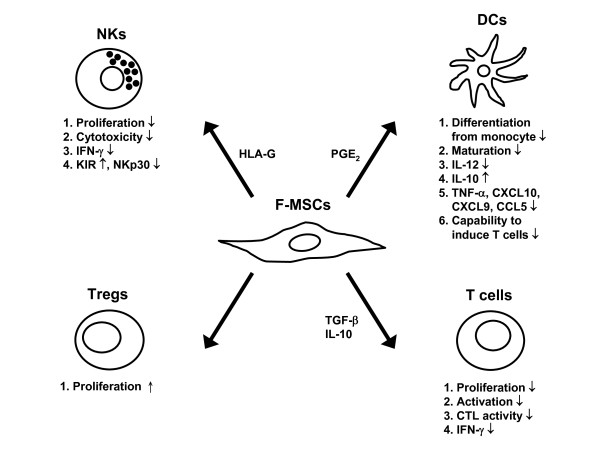
F-MSCs also have been reported to have strong inhibitory effects on T lymphocytes. hWJ-MSCs display potent immunosuppressive properties on T cell activation in an antigen-independent manner, and can also suppress the proliferation of mitogen-stimulated rat splenocytes (xenograft model) or human PBMCs (allogeneic transplant model) in allogeneic MLR in vitro. Furthermore, CD14+ monocytes promote the immunosuppressive effect of hWJ-MSCs probably via the IL-1β-PGE2 axis. The inflammatory cytokine IL-1β produced by hPBMCs upon activation upregulates the expression of cyclooxygenase-2 (COX-2) and the production of PGE2 by hWJ-MSCs. hP-MSCs can also suppress the proliferation of allogeneic T cells. These effects of hP-MSCs may involve the secretion of soluble factors TGF-β and IL-10. Both hP-MSCs and hUCB-MSCs have been shown to increase the proportion of Tregs, which contributes to the suppression of T cell proliferation (Figure 1).
Interestingly, a number of reports have demonstrated that in in vitro systems, pretreatment of BMMSCs and F-MSCs with the pro-inflammatory cytokine IFN-γ actually enhances their immunomodulation rather than decreases it. Some investigators have postulated that this may explain the in vivo ability of MSCs to be effective against very inflammatory diseases such as graft-versus-host-disease (GVHD), in which the production of such activating cytokines as IFN-γ by T and natural killer lymphocytes (NKs) may actually promote MSC immunomodulation, subsequently suppressing the proliferation of CD4+, CD8+ T cells, and NKs themselves. While this has not been proven in animal studies, pre-clinical and clinical data continues to reveal therapeutic efficacy after MSC administration, giving indirect evidence for this hypothesis. Interestingly, while IFN-γ pre-treatment of adult BMMSCs results in induction of IDO, a strong immunosuppressive enzyme, MHC II molecules--which can elicit inflammatory responses --are induced as well, but this does not appear to change the immunomodulatory effects of BMMSCs. It would be critical to elucidate this paradox to better understand why these progenitors possess such strong immunomodulatory properties inherently.
3.2 Interactions with Dendritic Cells (DCs)
DCs are derived from monocytes and are potent antigen-presenting cells (APCs) that act by internalizing, shuttling, and presenting antigens to naïve T-cells, which then leads to T-cell activation. These key regulators of immunity display an extraordinary capacity to induce T cell responses and secrete a variety of cytokines; the differentiation status of DCs can influence whether its target lymphocyte--often T cells--will mount an effector versus a more immunomodulatory response. As such, studies have shown that BMMSCs inhibit the immunostimulatory capacity of DCs, supporting the development of a more tolerogenic population of DCs. BMMSCs markedly impair PBMCs differentiation into DCs and inhibit endocytosis and the production of IL-12 by DCs. In the presence of BMMSCs, the differentiation of CD14+ monocytes into DCs is impaired, and the monocytes retain high expression of CD14+--a marker of immaturity for DCs--without the upregulation of CD1a, HLA-DR, or co-stimulatory molecules which prevent the DCs to efficiently induce T cell effector responses. In addition, BMMSCs also efficiently suppress the T cell-activating functions of DCs, including stimulation of T-cell proliferation, reduction of naïve CD4+ T lymphocytes polarizing into proinflammatory Th1 cells, and promotion of Th2 responses. BMMSCs can decrease TNF-α secretion by DCs, which then leads to a reduced number of IFN-γ-producing Th1 cells. APCs generated in the presence of BMMSCs express low levels of IL-12, TNF-α, and MHC class II and high levels of IL-1β and IL-10, regardless of CD86 expression. BMMSCs also induce DCs to secrete IL-10, which favors IL-4-producing Th2 cells and Tregs. Furthermore, BMMSCs impair the release of cytokines by activated DCs through PGE2. Both cell-to-cell contact and soluble factors such as IL-6 and macrophage-colony-stimulating factor (M-CSF) mediate the BMMSC-mediated inhibition of differentiation, cytokine production, and T-cell stimulatory capacity of DCs (Table 1).
Interestingly, there are studies which show that BMMSCs itself can function as non-professional APCs. It has been reported that IFN-γ-stimulated BMMSCs can present exogenous antigens through upregulation of MHC class II molecules, which then results in activation of CD4+ T cells. BMMSCs can also cross-present exogenous antigens to induce CD8+ T cell proliferation. A few studies have shown that BMMSCs--similar to DCs--express high levels of toll-like receptors (TLRs), including TLR1, TLR3, TLR4, and TLR5. TLRs are receptors primarily expressed on APCs which recognize conserved pathogen-derived components. Triggering of TLR3, which binds double-stranded RNA, and TLR4, which binds lipopolysaccharide (LPS) and innate self antigens, on BMMSCs has been reported to suppress the immunomodulation of these cells through Notch ⁄ Jagged1 signaling, leading to production of pro-inflammatory mediators such as IL-1β, IL-6, and IL-8. However, another report showed that triggering of TLR on BMMSCs actually induces immunosuppression, which leads to the production of immunosuppressive kynurenines induced by IDO1. IDO1 can be induced by TLR3 and TLR4 signaling and this involves the activation of protein kinase R (PKR), an autocrine IFN-β signaling loop, and the activation of signal transducer and activator of transcription 1 (STAT1)/interferon regulatory factor 1 (IRF-1). These conflicting data regarding BMMSCs suppressing DC maturation and BMMSCs itself being an APC eliciting pro-inflammatory responses will require more research for clarification. One possible reason for these discrepant findings is that there is much heterogeneity between BMMSCs isolated from laboratory to laboratory. While the recent consensus of cell surface profile and tri-lineage mesodermal differentiation requirement has been extremely helpful to unify BMMSC phenotype, there still may exist epigenetic differences due to organ of origin and donor age, just to name a few variables. Moreover, the immunomodulatory properties of MSCs from different organs have not been much investigated, and one comparative study suggests that the MSC niche is unique in each tissue, which can contributes to functional differences. Thus, it appears that studying the immunomodulatory behavior of MSCs derived from different origins would be important, and the accumulation of such data will help to shed more light and clarity on discrepant findings of this field.
Some studies have suggested that F-MSCs are poor APCs due to their low or limited expression of MHC class II and co-stimulatory molecules even after IFN-γ stimulation. Recent studies have also investigated whether F-MSCs modulate DC phenotype and function. hAMSCs exert immunomodulatory effects on APCs, as demonstrated by their capacity to block maturation of monocytes into DCs. They can prevent the expression of the DC lineage-specific marker CD1a and reduce the expression of HLA-DR, CD80, and CD83. This block in the monocyte-DC maturation process also results in impaired allostimulatory ability of these cells on allogeneic T cells. Remarkably, hUCB-MSCs modulate DCs in a different way. hUCB-MSCs suppress the function of mature DCs by driving DCs to an intermediate maturation state and boosting IL-12 production by mature DCs. These inhibitory mechanisms involve both cell-contact dependent as well as secretion of soluble factors (Figure 1).
3.3 Interactions with Natural Killer Lymphocytes (NKs)
NKs are key players of the innate immune system and are important in targeting virus-infected cells and tumor cells. NKs are highly cytotoxic and secrete large amounts of proinflammatory cytokines such as TNF-α and IFN-γ. Part of the innate immune system, these cytotoxic lymphocytes are triggered to recognize and respond to MHC molecules signifying "self" versus "non-self", rather than specific antigens which T and B lymphocytes of the adaptive immune system recognize. A few studies have shown that BMMSCs are able to suppress the proliferation and cytokine production of NKs. The inhibition requires both cell-to-cell contact and soluble factors such as PGE2 and TGF-β. BMMSCs can also modulate the cytotoxicity of NKs, reducing the levels of NK-secreted cytokines such as IFN-γ, IL-10, and TNF-α and this phenomenon also requires cell-cell contact. However, stimulated NKs can efficiently lyse autologous and allogeneic BMMSCs. The activating NK receptors NKp30, NKG2D, and DNAM-1 were involved in NK-mediated cytotoxicity against BMMSCs. IFN-γ-stimulated BMMSCs, on the other hand, were less susceptible to NK cell lysis as a consequence of the up-regulation of MHC class I molecules at the MSC surface. Moreover, the secretion of soluble HLA-G (sHLA-G) by BMMSCs plays an important role in the inhibition of NK cytotoxicity and IFN-γ release. First identified in choriocarcinoma and migratory trophoblasts, HLA-G (non-classical MHC I molecule) is thought to confer for the fetus a protective effect against the maternal immune system, including directly suppressing maternal NK cytotoxicity. HLA-G can exist in several forms, with the best characterized being the complete transmembrane form (HLA-G1)--the predominant in vivo form--and one of the three soluble, truncated forms (HLA-G5 or sHLA-G). Unlike most MHC I molecules, HLA-G has very low polymorphism and its expression in the adult is highly restricted; however, in certain pathologic states including cancer and inflammatory diseases, expression can be induced. The receptors for HLA-G include ILT-2, ILT-4, and CD94 and these receptors can be found on a number of leukocytes, most prominently being NKs (Table 1).
F-MSCs can express surface molecule HLA-G, indicating potential tolerance-inducing properties. We found that hP-MSCs are more resistant to stimulated-NK cytotoxicity than BMMSCs; moreover, hP-MSCs demonstrate enhanced suppressive effects towards NK in the presence of IFN-γ, and this is partially mediated through surface expression of HLA-G on hP-MSCs but not adult BMMSCs. The placenta is known to have unique immunomodulatory interactions with maternal uterine NKs, which also have a different effector profile than peripheral blood NKs. Thus, interactions of F-MSCs with NKs may be quite different than that found with BMMSCs, since NKs are one of the most important and predominant lymphocyte populations found during pregnancy. While such data is still scarce, research on F-MSCs interactions with this population of innate lymphocytes should yield interesting data, and perhaps even shed light on maternal-fetal immune mechanisms (Figure 1).
4. Clinical applications of adult and F-MSCs for GVHD
The majority of data on the immunomodulation of MSCs are in vitro in nature, however, a number of studies have been in vivo. One of the potentially lethal consequences after allogeneic HSCT is GVHD in which recipient cytotoxic T cells attack donor tissue, resulting in an immune-related complication which is associated with high morbidity and mortality. Animal models of GVHD are one of the most commonly used disease models to validate BMMSC immune function in vivo, and these studies have demonstrated that BMMSCs do remain immunomodulatory in vivo. Recent data has shown that the combination of BMMSCs and immunosuppressive drugs can prolong organ allograft survival. Because of the profound immunomodulatory effect of BMMSCs shown in vitro and in vivo, co-transplantation of ex vivo-expanded BMMSCs with HSCs for GVHD has been recommended. In addition, cytokines released by BMMSCs may promote homing or proliferation of HSCs and enhance HSCs engraftment. Thus, based on the accumulated in vitro and animal studies, a number of clinical trials have been started to evaluate the potential of BMMSCs for the treatment of GVHD.
While there are in general fewer studies using F-MSCs as a cell therapy source, some pre-clinical studies have been conducted. Several animal studies show the prolonged survival of hAMSCs with no evidence of immunological rejection after xenogeneic transplantation into immunocompetent animals including rats and swine. Moreover, hAF-MSCs appear to be relatively resistant to rejection by the recipient--even with allogenic cell transplantation--due to the expression of immunosuppressive factors such as CD59 (protectin) and HLA-G. Co-transplantation of UCBHSCs along with F-MSCs can reduce potential GVHD in recipients, as well as enhance UCB cell engraftment and homing of CD34+ HSCs. Therefore, F-MSCs appear to be a promising source for stem cell therapy of GVHD and likely other immune-related diseases.
5. Conclusions
MSCs are multilineage progenitors which can be isolated from many adult organs as well as fetal-stage tissues. BMMSCs and F-MSCs have been reported to harbor strong immunomodulatory effects. While the data is still scarce regarding F-MSCs, several differences in the immune-suppressive properties between F-MSCs and adult BMMSCs have been found. Future investigations on the molecular mechanisms underlying the immunomodulatory properties of both F-MSCs and adult BMMSCs would be important since these differences may have functional relevance to therapeutic use of both sources of progenitor cells.
Competing interests
The authors declare that they have no competing interests.
Authors' contributions
All authors have read and approved the final manuscript.
Acknowledgements and Funding
This work was supported by the National Science Council of Taiwan (grants NSC-99-3111-B-400-002, NSC 97-2320-B-400-005-MY3, and NSC-99-3112-B-400-006 to B.L.Y.; and NSC-99-3111-B-002-009 to M.L.Y.).
Sources
- PittengerMFMackayAMBeckSCJaiswalRKDouglasRMoscaJDMoormanMASimonettiDWCraigSMarshakDRMultilineage potential of adult human mesenchymal stem cellsScience19992845411143147 https://doi.org/10.1126/science.284.5411.143
- ProckopDJMarrow stromal cells as stem cells for nonhematopoietic tissuesScience199727653097174 https://doi.org/10.1126/science.276.5309.71
- FriedensteinAJPetrakovaKVKurolesovaAIFrolovaGPHeterotopic of bone marrow. Analysis of precursor cells for osteogenic and hematopoietic tissuesTransplantation196862230247 https://doi.org/10.1097/00007890-196803000-00009
- BrookeGCookMBlairCHanRHeazlewoodCJonesBKambourisMKollarKMcTaggartSPelekanosRTherapeutic applications of mesenchymal stromal cellsSemin Cell Dev Biol2007186846858 https://doi.org/10.1016/j.semcdb.2007.09.012
- ZukPAZhuMMizunoHHuangJFutrellJWKatzAJBenhaimPLorenzHPHedrickMHMultilineage cells from human adipose tissue: implications for cell-based therapiesTissue Eng200172211228 https://doi.org/10.1089/107632701300062859
- SottileVHalleuxCBassilanaFKellerHSeuwenKStem cell characteristics of human trabecular bone-derived cellsBone2002305699704 https://doi.org/10.1016/S8756-3282(02)00674-9
- NothUOsyczkaAMTuliRHickokNJDanielsonKGTuanRSMultilineage mesenchymal differentiation potential of human trabecular bone-derived cellsJ Orthop Res200220510601069 https://doi.org/10.1016/S0736-0266(02)00018-9
- YenBLHuangHIChienCCJuiHYKoBSYaoMShunCTYenMLLeeMCChenYCIsolation of multipotent cells from human term placentaStem Cells200523139 https://doi.org/10.1634/stemcells.2004-0098
- LeeOKKuoTKChenWMLeeKDHsiehSLChenTHIsolation of multipotent mesenchymal stem cells from umbilical cord bloodBlood2004103516691675 https://doi.org/10.1182/blood-2003-05-1670
- TsaiMSLeeJLChangYJHwangSMIsolation of human multipotent mesenchymal stem cells from second-trimester amniotic fluid using a novel two-stage culture protocolHum Reprod200419614501456 https://doi.org/10.1093/humrep/deh279
- WangHSHungSCPengSTHuangCCWeiHMGuoYJFuYSLaiMCChenCCMesenchymal stem cells in the Wharton's jelly of the human umbilical cordStem Cells200422713301337 https://doi.org/10.1634/stemcells.2004-0013
- GotherstromCRingdenOTammikCZetterbergEWestgrenMLe BlancKImmunologic properties of human fetal mesenchymal stem cellsAm J Obstet Gynecol20041901239245 https://doi.org/10.1016/j.ajog.2003.07.022
- CampagnoliCRobertsIAKumarSBennettPRBellantuonoIFiskNMIdentification of mesenchymal stem/progenitor cells in human first-trimester fetal blood, liver, and bone marrowBlood200198823962402 https://doi.org/10.1182/blood.V98.8.2396
- DominiciMLe BlancKMuellerISlaper-CortenbachIMariniFKrauseDDeansRKeatingAProckopDHorwitzEMinimal criteria for defining multipotent mesenchymal stromal cells. The International Society for Cellular Therapy position statementCytotherapy200684315317 https://doi.org/10.1080/14653240600855905
- PicinichSCMishraPJMishraPJGlodJBanerjeeDThe therapeutic potential of mesenchymal stem cells. Cell- & tissue-based therapyExpert Opin Biol Ther200777965973 https://doi.org/10.1517/14712598.7.7.965
- GiordanoAGalderisiUMarinoIRFrom the laboratory bench to the patient's bedside: an update on clinical trials with mesenchymal stem cellsJ Cell Physiol200721112735 https://doi.org/10.1002/jcp.20959
- BartholomewASturgeonCSiatskasMFerrerKMcIntoshKPatilSHardyWDevineSUckerDDeansRMesenchymal stem cells suppress lymphocyte proliferation in vitro and prolong skin graft survival in vivoExp Hematol20023014248 https://doi.org/10.1016/S0301-472X(01)00769-X
- Le BlancKTammikCRosendahlKZetterbergERingdenOHLA expression and immunologic properties of differentiated and undifferentiated mesenchymal stem cellsExp Hematol20033110890896 https://doi.org/10.1016/S0301-472X(03)00110-3
- Di NicolaMCarlo-StellaCMagniMMilanesiMLongoniPDMatteucciPGrisantiSGianniAMHuman bone marrow stromal cells suppress T-lymphocyte proliferation induced by cellular or nonspecific mitogenic stimuliBlood2002991038383843 https://doi.org/10.1182/blood.V99.10.3838
- DeanRMBishopMRGraft-versus-host disease: emerging concepts in prevention and therapyCurr Hematol Rep200324287294 https://pubmed.ncbi.nlm.nih.gov/12901325/
- BarkerJNWagnerJEUmbilical cord blood transplantation: current practice and future innovationsCrit Rev Oncol Hematol20034813543 https://doi.org/10.1016/S1040-8428(03)00092-1
- Le BlancKFrassoniFBallLLocatelliFRoelofsHLewisILaninoESundbergBBernardoMERembergerMMesenchymal stem cells for treatment of steroid-resistant, severe, acute graft-versus-host disease: a phase II studyLancet2008371962415791586 https://doi.org/10.1016/S0140-6736(08)60690-X
- JurewiczMYangSAugelloAGodwinJGMooreRFAzziJFiorinaPAtkinsonMSayeghMHAbdiRCongenic mesenchymal stem cell therapy reverses hyperglycemia in experimental type 1 diabetesDiabetes2010591231393147 https://doi.org/10.2337/db10-0542
- NemethKLeelahavanichkulAYuenPSMayerBParmeleeADoiKRobeyPGLeelahavanichkulKKollerBHBrownJMBone marrow stromal cells attenuate sepsis via prostaglandin E2-dependent reprogramming of host macrophages to increase their interleukin-10 productionNat Med20091514249 https://doi.org/10.1038/nm.1905
- AugelloATassoRNegriniSMCanceddaRPennesiGCell therapy using allogeneic bone marrow mesenchymal stem cells prevents tissue damage in collagen-induced arthritisArthritis Rheum200756411751186 https://doi.org/10.1002/art.22511
- Le BlancKRasmussonISundbergBGotherstromCHassanMUzunelMRingdenOTreatment of severe acute graft-versus-host disease with third party haploidentical mesenchymal stem cellsLancet2004363941914391441 https://doi.org/10.1016/S0140-6736(04)16104-7
- BarryFPMurphyJMEnglishKMahonBPImmunogenicity of adult mesenchymal stem cells: lessons from the fetal allograftStem Cells Dev2005143252265 https://doi.org/10.1089/scd.2005.14.252
- MajumdarMKKeane-MooreMBuyanerDHardyWBMoormanMAMcIntoshKRMoscaJDCharacterization and functionality of cell surface molecules on human mesenchymal stem cellsJ Biomed Sci2003102228241 https://doi.org/10.1007/BF02256058
- TseWTPendletonJDBeyerWMEgalkaMCGuinanECSuppression of allogeneic T-cell proliferation by human marrow stromal cells: implications in transplantationTransplantation2003753389397 https://doi.org/10.1097/01.TP.0000045055.63901.A9
- KlyushnenkovaEMoscaJDZernetkinaVMajumdarMKBeggsKJSimonettiDWDeansRJMcIntoshKRT cell responses to allogeneic human mesenchymal stem cells: immunogenicity, tolerance, and suppressionJ Biomed Sci20051214757 https://doi.org/10.1007/s11373-004-8183-7
- StenderupKJustesenJClausenCKassemMAging is associated with decreased maximal life span and accelerated senescence of bone marrow stromal cellsBone2003336919926 https://doi.org/10.1016/j.bone.2003.07.005
- de BraudFKhayatDKroonBBValdagniRBruzziPCascinelliNMalignant melanomaCrit Rev Oncol Hematol20034713563 https://doi.org/10.1016/S1040-8428(02)00077-X
- EricesACongetPMinguellJJMesenchymal progenitor cells in human umbilical cord bloodBr J Haematol20001091235242 https://doi.org/10.1046/j.1365-2141.2000.01986.x
- SarugaserRLickorishDBakshDHosseiniMMDaviesJEHuman umbilical cord perivascular (HUCPV) cells: a source of mesenchymal progenitorsStem Cells2005232220229 https://doi.org/10.1634/stemcells.2004-0166
- In 't AnkerPSScherjonSAKleijburg-van der KeurCNoortWAClaasFHWillemzeRFibbeWEKanhaiHHAmniotic fluid as a novel source of mesenchymal stem cells for therapeutic transplantationBlood2003102415481549 https://doi.org/10.1182/blood-2003-04-1291
- BachmannMFKohlerGEcabertBMakTWKopfMLymphoproliferative disease in the absence of CTLA-4 is not T cell autonomousJ Immunol1999163311281131 https://pubmed.ncbi.nlm.nih.gov/10415006/
- FukuchiYNakajimaHSugiyamaDHiroseIKitamuraTTsujiKHuman placenta-derived cells have mesenchymal stem/progenitor cell potentialStem Cells2004225649658 https://doi.org/10.1634/stemcells.22-5-649
- WulfGGViereckVHemmerleinBHaaseDVehmeyerKPukropTGlassBEmonsGTrumperLMesengenic progenitor cells derived from human placentaTissue Eng2004107-811361147 https://doi.org/10.1089/ten.2004.10.1136
- In 't AnkerPSScherjonSAKleijburg-van der KeurCde Groot-SwingsGMClaasFHFibbeWEKanhaiHHIsolation of mesenchymal stem cells of fetal or maternal origin from human placentaStem Cells200422713381345 https://doi.org/10.1634/stemcells.2004-0058
- ChangCJYenMLChenYCChienCCHuangHIBaiCHYenBLPlacenta-derived multipotent cells exhibit immunosuppressive properties that are enhanced in the presence of interferon-gammaStem Cells2006241124662477 https://doi.org/10.1634/stemcells.2006-0071
- ChiavegatoABolliniSPozzobonMCallegariAGasparottoLTaianiJPiccoliMLenziniEGerosaGVendraminIHuman amniotic fluid-derived stem cells are rejected after transplantation in the myocardium of normal, ischemic, immuno-suppressed or immuno-deficient ratJ Mol Cell Cardiol2007424746759 https://doi.org/10.1016/j.yjmcc.2006.12.008
- HaoLZhangCChenXHZouZMZhangXKongPYLiangXGaoLPengXGSunAHHuman umbilical cord blood-derived stromal cells suppress xenogeneic immune cell response in vitroCroat Med J2009504351360 https://doi.org/10.3325/cmj.2009.50.351
- IlancheranSMichalskaAPehGWallaceEMPeraMManuelpillaiUStem cells derived from human fetal membranes display multilineage differentiation potentialBiol Reprod2007773577588 https://doi.org/10.1095/biolreprod.106.055244
- KimJLeeYKimHHwangKJKwonHCKimSKChoDJKangSGYouJHuman amniotic fluid-derived stem cells have characteristics of multipotent stem cellsCell Prolif20074017590 https://doi.org/10.1111/j.1365-2184.2007.00414.x
- LuLLLiuYJYangSGZhaoQJWangXGongWHanZBXuZSLuYXLiuDIsolation and characterization of human umbilical cord mesenchymal stem cells with hematopoiesis-supportive function and other potentialsHaematologica200691810171026 https://pubmed.ncbi.nlm.nih.gov/16870554/
- OhWKimDSYangYSLeeJKImmunological properties of umbilical cord blood-derived mesenchymal stromal cellsCell Immunol20082512116123 https://doi.org/10.1016/j.cellimm.2008.04.003
- Portmann-LanzCBSchoeberleinAHuberASagerRMalekAHolzgreveWSurbekDVPlacental mesenchymal stem cells as potential autologous graft for pre- and perinatal neuroregenerationAm J Obstet Gynecol20061943664673 https://doi.org/10.1016/j.ajog.2006.01.101
- RoubelakisMGPappaKIBitsikaVZagouraDVlahouAPapadakiHAAntsaklisAAnagnouNPMolecular and proteomic characterization of human mesenchymal stem cells derived from amniotic fluid: comparison to bone marrow mesenchymal stem cellsStem Cells Dev2007166931952 https://doi.org/10.1089/scd.2007.0036
- TeradaSMatsuuraKEnosawaSMikiMHoshikaASuzukiSSakuragawaNInducing proliferation of human amniotic epithelial (HAE) cells for cell therapyCell Transplant200095701704 https://doi.org/10.1177/096368970000900518
- WangMYangYYangDLuoFLiangWGuoSXuJThe immunomodulatory activity of human umbilical cord blood-derived mesenchymal stem cells in vitroImmunology20091262220232 https://doi.org/10.1111/j.1365-2567.2008.02891.x
- WeissMLAndersonCMedicettySSeshareddyKBWeissRJVanderWerffITroyerDMcIntoshKRImmune properties of human umbilical cord Wharton's jelly-derived cellsStem Cells2008261128652874 https://doi.org/10.1634/stemcells.2007-1028
- WeissMLMedicettySBledsoeARRachakatlaRSChoiMMerchavSLuoYRaoMSVelagaletiGTroyerDHuman umbilical cord matrix stem cells: preliminary characterization and effect of transplantation in a rodent model of Parkinson's diseaseStem Cells2006243781792 https://doi.org/10.1634/stemcells.2005-0330
- LiCZhangWJiangXMaoNHuman-placenta-derived mesenchymal stem cells inhibit proliferation and function of allogeneic immune cellsCell Tissue Res20073303437446 https://doi.org/10.1007/s00441-007-0504-5
- WolbankSPeterbauerAFahrnerMHennerbichlerSvan GriensvenMStadlerGRedlHGabrielCDose-dependent immunomodulatory effect of human stem cells from amniotic membrane: a comparison with human mesenchymal stem cells from adipose tissueTissue Eng200713611731183 https://doi.org/10.1089/ten.2006.0313
- MagattiMDe MunariSVertuaEGibelliLWenglerGSParoliniOHuman amnion mesenchyme harbors cells with allogeneic T-cell suppression and stimulation capabilitiesStem Cells2008261182192 https://doi.org/10.1634/stemcells.2007-0491
- BailoMSonciniMVertuaESignoroniPBSanzoneSLombardiGArientiDCalamaniFZattiDPaulPEngraftment potential of human amnion and chorion cells derived from term placentaTransplantation2004781014391448 https://doi.org/10.1097/01.TP.0000144606.84234.49
- LiHNiederkornJYNeelamSMayhewEWordRAMcCulleyJPAlizadehHImmunosuppressive factors secreted by human amniotic epithelial cellsInvest Ophthalmol Vis Sci2005463900907 https://doi.org/10.1167/iovs.04-0495
- AggarwalSPittengerMFHuman mesenchymal stem cells modulate allogeneic immune cell responsesBlood2005105418151822 https://doi.org/10.1182/blood-2004-04-1559
- KramperaMCosmiLAngeliRPasiniALiottaFAndreiniASantarlasciVMazzinghiBPizzoloGVinanteFRole for interferon-gamma in the immunomodulatory activity of human bone marrow mesenchymal stem cellsStem Cells2006242386398 https://doi.org/10.1634/stemcells.2005-0008
- KramperaMGlennieSDysonJScottDLaylorRSimpsonEDazziFBone marrow mesenchymal stem cells inhibit the response of naive and memory antigen-specific T cells to their cognate peptideBlood2003101937223729 https://doi.org/10.1182/blood-2002-07-2104
- GlennieSSoeiroIDysonPJLamEWDazziFBone marrow mesenchymal stem cells induce division arrest anergy of activated T cellsBlood2005105728212827 https://doi.org/10.1182/blood-2004-09-3696
- BenvenutoFFerrariSGerdoniEGualandiFFrassoniFPistoiaVMancardiGUccelliAHuman mesenchymal stem cells promote survival of T cells in a quiescent stateStem Cells200725717531760 https://doi.org/10.1634/stemcells.2007-0068
- ZhouLChongMMLittmanDRPlasticity of CD4+ T cell lineage differentiationImmunity2009305646655 https://doi.org/10.1016/j.immuni.2009.05.001
- BaiLLennonDPEatonVMaierKCaplanAIMillerSDMillerRHHuman bone marrow-derived mesenchymal stem cells induce Th2-polarized immune response and promote endogenous repair in animal models of multiple sclerosisGlia2009571111921203 https://doi.org/10.1002/glia.20841
- RafeiMCampeauPMAguilar-MahechaABuchananMWilliamsPBirmanEYuanSYoungYKBoivinMNFornerKMesenchymal stromal cells ameliorate experimental autoimmune encephalomyelitis by inhibiting CD4 Th17 T cells in a CC chemokine ligand 2-dependent mannerJ Immunol20091821059946002 https://doi.org/10.4049/jimmunol.0803962
- GhannamSPeneJTorcy-MoquetGJorgensenCYsselHMesenchymal stem cells inhibit human Th17 cell differentiation and function and induce a T regulatory cell phenotypeJ Immunol20101851302312 https://doi.org/10.4049/jimmunol.0902007
- MaccarioRPodestaMMorettaACometaAComoliPMontagnaDDaudtLIbaticiAPiaggioGPozziSInteraction of human mesenchymal stem cells with cells involved in alloantigen-specific immune response favors the differentiation of CD4+ T-cell subsets expressing a regulatory/suppressive phenotypeHaematologica2005904516525 https://pubmed.ncbi.nlm.nih.gov/15820948/
- RileyJLJuneCHBlazarBRHuman T regulatory cell therapy: take a billion or so and call me in the morningImmunity2009305656665 https://doi.org/10.1016/j.immuni.2009.04.006
- ShevachEMMechanisms of foxp3+ T regulatory cell-mediated suppressionImmunity2009305636645 https://doi.org/10.1016/j.immuni.2009.04.010
- ItohMTakahashiTSakaguchiNKuniyasuYShimizuJOtsukaFSakaguchiSThymus and autoimmunity: production of CD25+CD4+ naturally anergic and suppressive T cells as a key function of the thymus in maintaining immunologic self-toleranceJ Immunol1999162953175326 https://pubmed.ncbi.nlm.nih.gov/10228007/
- EnglishKRyanJMTobinLMurphyMJBarryFPMahonBPCell contact, prostaglandin E2 and transforming growth factor beta 1 play non-redundant roles in human mesenchymal stem cell induction of CD4+CD25Highforkhead box P3+ regulatory T cellsClin Exp Immunol20091561149160 https://doi.org/10.1111/j.1365-2249.2009.03874.x
- PrevostoCZancolliMCanevaliPZocchiMRPoggiAGeneration of CD4+ or CD8+ regulatory T cells upon mesenchymal stem cell-lymphocyte interactionHaematologica2007927881888 https://doi.org/10.3324/haematol.11240
- Di IanniMDel PapaBDe IoanniMMorettiLBonifacioECecchiniDSportolettiPFalzettiFTabilioAMesenchymal cells recruit and regulate T regulatory cellsExp Hematol2008363309318 https://doi.org/10.1016/j.exphem.2007.11.007
- SelmaniZNajiAZidiIFavierBGaiffeEObertLBorgCSaasPTiberghienPRouas-FreissNHuman leukocyte antigen-G5 secretion by human mesenchymal stem cells is required to suppress T lymphocyte and natural killer function and to induce CD4+CD25highFOXP3+ regulatory T cellsStem Cells2008261212222 https://doi.org/10.1634/stemcells.2007-0554
- BattenPSarathchandraPAntoniwJWTaySSLowdellMWTaylorPMYacoubMHHuman mesenchymal stem cells induce T cell anergy and downregulate T cell allo-responses via the TH2 pathway: relevance to tissue engineering human heart valvesTissue Eng200612822632273 https://doi.org/10.1089/ten.2006.12.2263
- RasmussonIImmune modulation by mesenchymal stem cellsExp Cell Res20063121221692179 https://doi.org/10.1016/j.yexcr.2006.03.019
- GrohMEMaitraBSzekelyEKocONHuman mesenchymal stem cells require monocyte-mediated activation to suppress alloreactive T cellsExp Hematol2005338928934 https://doi.org/10.1016/j.exphem.2005.05.002
- RasmussonIRingdenOSundbergBLe BlancKMesenchymal stem cells inhibit lymphocyte proliferation by mitogens and alloantigens by different mechanismsExp Cell Res200530513341 https://doi.org/10.1016/j.yexcr.2004.12.013
- RyanJMBarryFMurphyJMMahonBPInterferon-gamma does not break, but promotes the immunosuppressive capacity of adult human mesenchymal stem cellsClin Exp Immunol20071492353363 https://doi.org/10.1111/j.1365-2249.2007.03422.x
- MeiselRZibertALaryeaMGobelUDaubenerWDillooDHuman bone marrow stromal cells inhibit allogeneic T-cell responses by indoleamine 2,3-dioxygenase-mediated tryptophan degradationBlood20041031246194621 https://doi.org/10.1182/blood-2003-11-3909
- PlumasJChaperotLRichardMJMolensJPBensaJCFavrotMCMesenchymal stem cells induce apoptosis of activated T cellsLeukemia200519915971604 https://doi.org/10.1038/sj.leu.2403871
- ChabannesDHillMMerieauERossignolJBrionRSoulillouJPAnegonICuturiMCA role for heme oxygenase-1 in the immunosuppressive effect of adult rat and human mesenchymal stem cellsBlood20071101036913694 https://doi.org/10.1182/blood-2007-02-075481
- NasefAMazurierCBouchetSFrancoisSChapelAThierryDGorinNCFouillardLLeukemia inhibitory factor: Role in human mesenchymal stem cells mediated immunosuppressionCell Immunol20082531-21622 https://doi.org/10.1016/j.cellimm.2008.06.002
- GiesekeFSchuttBViebahnSKoscielniakEFriedrichWHandgretingerRMullerIHuman multipotent mesenchymal stromal cells inhibit proliferation of PBMCs independently of IFNgammaR1 signaling and IDO expressionBlood2007110621972200 https://doi.org/10.1182/blood-2007-04-083162
- NasefAMathieuNChapelAFrickJFrancoisSMazurierCBoutarfaABouchetSGorinNCThierryDImmunosuppressive effects of mesenchymal stem cells: involvement of HLA-GTransplantation2007842231237 https://doi.org/10.1097/01.tp.0000267918.07906.08
- GiesekeFBohringerJBussolariRDominiciMHandgretingerRMullerIHuman multipotent mesenchymal stromal cells use galectin-1 to inhibit immune effector cellsBlood20101161937703779 https://doi.org/10.1182/blood-2010-02-270777
- SioudMMobergslienABoudabousAFloisandYMesenchymal stem cell-mediated T cell suppression occurs through secreted galectinsInt J Oncol2011382385390 https://doi.org/10.3892/ijo.2010.869
- LiottaFAngeliRCosmiLFiliLManuelliCFrosaliFMazzinghiBMaggiLPasiniALisiVToll-like receptors 3 and 4 are expressed by human bone marrow-derived mesenchymal stem cells and can inhibit their T-cell modulatory activity by impairing Notch signalingStem Cells2008261279289 https://doi.org/10.1634/stemcells.2007-0454
- WangDChenKDuWTHanZBRenHChiYYangSGBayardFZhuDHanZCCD14+ monocytes promote the immunosuppressive effect of human umbilical cord matrix stem cellsExp Cell Res20103161524142423 https://doi.org/10.1016/j.yexcr.2010.04.018
- CutlerAJLimbaniVGirdlestoneJNavarreteCVUmbilical cord-derived mesenchymal stromal cells modulate monocyte function to suppress T cell proliferationJ Immunol20101851166176623 https://doi.org/10.4049/jimmunol.1002239
- ChenKWangDDuWTHanZBRenHChiYYangSGZhuDBayardFHanZCHuman umbilical cord mesenchymal stem cells hUC-MSCs exert immunosuppressive activities through a PGE2-dependent mechanismClin Immunol20101353448458 https://doi.org/10.1016/j.clim.2010.01.015
- GirdlestoneJLimbaniVACutlerAJNavarreteCVEfficient expansion of mesenchymal stromal cells from umbilical cord under low serum conditionsCytotherapy2009116738748 https://doi.org/10.3109/14653240903079401
- ZhangYLiCJiangXZhangSWuYLiuBTangPMaoNHuman placenta-derived mesenchymal progenitor cells support culture expansion of long-term culture-initiating cells from cord blood CD34+ cellsExp Hematol2004327657664 https://doi.org/10.1016/j.exphem.2004.04.001
- RoelenDLvan der MastBJin't AnkerPSKleijburgCEikmansMvan BeelenEde Groot-SwingsGMFibbeWEKanhaiHHScherjonSADifferential immunomodulatory effects of fetal versus maternal multipotent stromal cellsHum Immunol20097011623 https://doi.org/10.1016/j.humimm.2008.10.016
- PrasannaSJGopalakrishnanDShankarSRVasandanABPro-inflammatory cytokines, IFNgamma and TNFalpha, influence immune properties of human bone marrow and Wharton jelly mesenchymal stem cells differentiallyPLoS One201052e9016. https://doi.org/10.1371/journal.pone.0009016
- JonesEYFuggerLStromingerJLSieboldCMHC class II proteins and disease: a structural perspectiveNat Rev Immunol200664271282 https://doi.org/10.1038/nri1805
- SteinmanRMPackMInabaKDendritic cells in the T-cell areas of lymphoid organsImmunol Rev19971562537 https://doi.org/10.1111/j.1600-065X.1997.tb00956.x
- JiangXXZhangYLiuBZhangSXWuYYuXDMaoNHuman mesenchymal stem cells inhibit differentiation and function of monocyte-derived dendritic cellsBlood20051051041204126 https://doi.org/10.1182/blood-2004-02-0586
- SpaggiariGMAbdelrazikHBecchettiFMorettaLMSCs inhibit monocyte-derived DC maturation and function by selectively interfering with the generation of immature DCs: central role of MSC-derived prostaglandin E2Blood20091132665766583 https://doi.org/10.1182/blood-2009-02-203943
- BeythSBorovskyZMevorachDLiebergallMGazitZAslanHGalunERachmilewitzJHuman mesenchymal stem cells alter antigen-presenting cell maturation and induce T-cell unresponsivenessBlood2005105522142219 https://doi.org/10.1182/blood-2004-07-2921
- LiYPPaczesnySLauretEPoiraultSBordigoniPMekhloufiFHequetOBertrandYOu-YangJPStoltzJFHuman mesenchymal stem cells license adult CD34+ hemopoietic progenitor cells to differentiate into regulatory dendritic cells through activation of the Notch pathwayJ Immunol2008180315981608 https://doi.org/10.4049/jimmunol.180.3.1598
- ChanWKLauASLiJCLawHKLauYLChanGCMHC expression kinetics and immunogenicity of mesenchymal stromal cells after short-term IFN-gamma challengeExp Hematol2008361115451555 https://doi.org/10.1016/j.exphem.2008.06.008
- StaggJPommeySEliopoulosNGalipeauJInterferon-gamma-stimulated marrow stromal cells: a new type of nonhematopoietic antigen-presenting cellBlood2006107625702577 https://doi.org/10.1182/blood-2005-07-2793
- ChanJLTangKCPatelAPBonillaLMPierobonNPonzioNMRameshwarPAntigen-presenting property of mesenchymal stem cells occurs during a narrow window at low levels of interferon-gammaBlood20061071248174824 https://doi.org/10.1182/blood-2006-01-0057
- FrancoisMRomieu-MourezRStock-MartineauSBoivinMNBramsonJLGalipeauJMesenchymal stromal cells cross-present soluble exogenous antigens as part of their antigen-presenting cell propertiesBlood20091141326322638 https://doi.org/10.1182/blood-2009-02-207795
- MorandiFRaffaghelloLBianchiGMeloniFSalisAMilloEFerroneSBarnabaVPistoiaVImmunogenicity of human mesenchymal stem cells in HLA-class I-restricted T-cell responses against viral or tumor-associated antigensStem Cells200826512751287 https://doi.org/10.1634/stemcells.2007-0878
- Romieu-MourezRFrancoisMBoivinMNBouchentoufMSpanerDEGalipeauJCytokine modulation of TLR expression and activation in mesenchymal stromal cells leads to a proinflammatory phenotypeJ Immunol20091821279637973 https://doi.org/10.4049/jimmunol.0803864
- Pevsner-FischerMMoradVCohen-SfadyMRousso-NooriLZanin-ZhorovACohenSCohenIRZiporiDToll-like receptors and their ligands control mesenchymal stem cell functionsBlood2007109414221432 https://doi.org/10.1182/blood-2006-06-028704
- TomchuckSLZwezdarykKJCoffeltSBWatermanRSDankaESScandurroABToll-like receptors on human mesenchymal stem cells drive their migration and immunomodulating responsesStem Cells200826199107 https://doi.org/10.1634/stemcells.2007-0563
- OpitzCALitzenburgerUMLutzCLanzTVTritschlerIKoppelATolosaEHobergMAnderlJAicherWKToll-like receptor engagement enhances the immunosuppressive properties of human bone marrow-derived mesenchymal stem cells by inducing indoleamine-2,3-dioxygenase-1 via interferon-beta and protein kinase RStem Cells2009274909919 https://doi.org/10.1002/stem.7
- KernSEichlerHStoeveJKluterHBiebackKComparative analysis of mesenchymal stem cells from bone marrow, umbilical cord blood, or adipose tissueStem Cells200624512941301 https://doi.org/10.1634/stemcells.2005-0342
- ParoliniOAlvianoFBagnaraGPBilicGBuhringHJEvangelistaMHennerbichlerSLiuBMagattiMMaoNIsolation and characterization of cells from human term placenta: outcome of the first international Workshop on Placenta Derived Stem CellsStem Cells2008262300311 https://doi.org/10.1634/stemcells.2007-0594
- MagattiMDe MunariSVertuaENassautoCAlbertiniAWenglerGSParoliniOAmniotic mesenchymal tissue cells inhibit dendritic cell differentiation of peripheral blood and amnion resident monocytesCell Transplant2009188899914 https://doi.org/10.3727/096368909X471314
- KronsteinerBPeterbauer-ScherbAGrillari-VoglauerRRedlHGabrielCvan GriensvenMWolbankSHuman mesenchymal stem cells and renal tubular epithelial cells differentially influence monocyte-derived dendritic cell differentiation and maturationCell Immunol201126713038 https://doi.org/10.1016/j.cellimm.2010.11.001
- van den BerkLCRoelofsHHuijsTSiebers-VermeulenKGRaymakersRAKoglerGFigdorCGTorensmaRCord blood mesenchymal stem cells propel human dendritic cells to an intermediate maturation state and boost interleukin-12 production by mature dendritic cellsImmunology20091284564572 https://doi.org/10.1111/j.1365-2567.2009.03142.x
- MorettaALocatelliFMorettaLHuman NK cells: from HLA class I-specific killer Ig-like receptors to the therapy of acute leukemiasImmunol Rev20082245869 https://doi.org/10.1111/j.1600-065X.2008.00651.x
- CaligiuriMAHuman natural killer cellsBlood20081123461469 https://doi.org/10.1182/blood-2007-09-077438
- SotiropoulouPAPerezSAGritzapisADBaxevanisCNPapamichailMInteractions between human mesenchymal stem cells and natural killer cellsStem Cells20062417485 https://doi.org/10.1634/stemcells.2004-0359
- SpaggiariGMCapobiancoAAbdelrazikHBecchettiFMingariMCMorettaLMesenchymal stem cells inhibit natural killer-cell proliferation, cytotoxicity, and cytokine production: role of indoleamine 2,3-dioxygenase and prostaglandin E2Blood2008111313271333 https://doi.org/10.1182/blood-2007-02-074997
- PoggiAZocchiMRAntigen presenting cells and stromal cells trigger human natural killer lymphocytes to autoreactivity: evidence for the involvement of natural cytotoxicity receptors (NCR) and NKG2DClin Dev Immunol2006132-4325336 https://doi.org/10.1080/17402520600578194
- SpaggiariGMCapobiancoABecchettiSMingariMCMorettaLMesenchymal stem cell-natural killer cell interactions: evidence that activated NK cells are capable of killing MSCs, whereas MSCs can inhibit IL-2-induced NK-cell proliferationBlood2006107414841490 https://doi.org/10.1182/blood-2005-07-2775
- Rouas-FreissNGoncalvesRMMenierCDaussetJCarosellaEDDirect evidence to support the role of HLA-G in protecting the fetus from maternal uterine natural killer cytolysisProc Natl Acad Sci USA199794211152011525 https://doi.org/10.1073/pnas.94.21.11520
- AppsRGardnerLMoffettAA critical look at HLA-GTrends Immunol2008297313321 https://doi.org/10.1016/j.it.2008.02.012
- CarosellaEDFavierBRouas-FreissNMoreauPLemaoultJBeyond the increasing complexity of the immunomodulatory HLA-G moleculeBlood20081111048624870 https://doi.org/10.1182/blood-2007-12-127662
- LeMaoultJZafaranlooKLe DanffCCarosellaEDHLA-G up-regulates ILT2, ILT3, ILT4, and KIR2DL4 in antigen presenting cells, NK cells, and T cellsFASEB J2005196662664 https://doi.org/10.1096/fj.04-1617fje
- La RoccaGAnzaloneRCorraoSMagnoFLoriaTLo IaconoMDi StefanoAGiannuzziPMarasaLCappelloFIsolation and characterization of Oct-4+/HLA-G+ mesenchymal stem cells from human umbilical cord matrix: differentiation potential and detection of new markersHistochem Cell Biol20091312267282 https://doi.org/10.1007/s00418-008-0519-3
- LiuKJWangJCChangCJHuHIHsuPJWuYCBaiCHSytwuHKYenBLSurface expression of HLA-G is involved in mediating immunomodulatory effects of placenta-derived multipotent cells (PDMCs) towards natural killer lymphocytesCell Transplant2011 in press https://doi.org/10.3727/096368911X580590
- GauntGRaminKImmunological tolerance of the human fetusAm J Perinatol2001186299312 https://doi.org/10.1055/s-2001-17861
- Moffett-KingANatural killer cells and pregnancyNat Rev Immunol200229656663 https://doi.org/10.1038/nri886
- DeegHJHow I treat refractory acute GVHDBlood20071091041194126 https://doi.org/10.1182/blood-2006-12-041889
- AksuAEHoribeESacksJIkeguchiRBreitingerJScozioMUnadkatJFeili-HaririMCo-infusion of donor bone marrow with host mesenchymal stem cells treats GVHD and promotes vascularized skin allograft survival in ratsClin Immunol20081273348358 https://doi.org/10.1016/j.clim.2008.02.003
- ZhouHPYiDHYuSQSunGCCuiQZhuHLLiuJCZhangJZWuTJAdministration of donor-derived mesenchymal stem cells can prolong the survival of rat cardiac allograftTransplant Proc200638930463051 https://doi.org/10.1016/j.transproceed.2006.10.002
- YanezRLamanaMLGarcia-CastroJColmeneroIRamirezMBuerenJAAdipose tissue-derived mesenchymal stem cells have in vivo immunosuppressive properties applicable for the control of the graft-versus-host diseaseStem Cells2006241125822591 https://doi.org/10.1634/stemcells.2006-0228
- KimDWChungYJKimTGKimYLOhIHCotransplantation of third-party mesenchymal stromal cells can alleviate single-donor predominance and increase engraftment from double cord transplantationBlood2004103519411948 https://doi.org/10.1182/blood-2003-05-1601
- GeWJiangJBarojaMLArpJZassokoRLiuWBartholomewAGarciaBWangHInfusion of mesenchymal stem cells and rapamycin synergize to attenuate alloimmune responses and promote cardiac allograft toleranceAm J Transplant20099817601772 https://doi.org/10.1111/j.1600-6143.2009.02721.x
- PoppFCEggenhoferERennerPSlowikPLangSAKasparHGeisslerEKPisoPSchlittHJDahlkeMHMesenchymal stem cells can induce long-term acceptance of solid organ allografts in synergy with low-dose mycophenolateTranspl Immunol2008201-25560 https://doi.org/10.1016/j.trim.2008.08.004
- von BoninMStolzelFGoedeckeARichterKWuschekNHoligKPlatzbeckerUIllmerTSchaichMScheteligJTreatment of refractory acute GVHD with third-party MSC expanded in platelet lysate-containing mediumBone Marrow Transplant2009433245251 https://doi.org/10.1038/bmt.2008.316
- FangBSongYLiaoLZhangYZhaoRCFavorable response to human adipose tissue-derived mesenchymal stem cells in steroid-refractory acute graft-versus-host diseaseTransplant Proc2007391033583362 https://doi.org/10.1016/j.transproceed.2007.08.103
- MullerIKordowichSHolzwarthCIsenseeGLangPNeunhoefferFDominiciMGreilJHandgretingerRApplication of multipotent mesenchymal stromal cells in pediatric patients following allogeneic stem cell transplantationBlood Cells Mol Dis20084012532 https://doi.org/10.1016/j.bcmd.2007.06.021
- LazarusHMKocONDevineSMCurtinPMaziarzRTHollandHKShpallEJMcCarthyPAtkinsonKCooperBWCotransplantation of HLA-identical sibling culture-expanded mesenchymal stem cells and hematopoietic stem cells in hematologic malignancy patientsBiol Blood Marrow Transplant2005115389398 https://doi.org/10.1016/j.bbmt.2005.02.001
- NingHYangFJiangMHuLFengKZhangJYuZLiBXuCLiYThe correlation between cotransplantation of mesenchymal stem cells and higher recurrence rate in hematologic malignancy patients: outcome of a pilot clinical studyLeukemia2008223593599 https://doi.org/10.1038/sj.leu.2405090
- TaupinPOTI-010 Osiris Therapeutics/JCR PharmaceuticalsCurr Opin Investig Drugs200675473481 https://pubmed.ncbi.nlm.nih.gov/16729725/
- VianelloFDazziFMesenchymal stem cells for graft-versus-host disease: a double edged sword?Leukemia2008223463465 https://doi.org/10.1038/leu.2008.25
- SundinMRingdenOSundbergBNavaSGotherstromCLe BlancKNo alloantibodies against mesenchymal stromal cells, but presence of anti-fetal calf serum antibodies, after transplantation in allogeneic hematopoietic stem cell recipientsHaematologica200792912081215 https://doi.org/10.3324/haematol.11446
- Le BlancKRingdenOImmunobiology of human mesenchymal stem cells and future use in hematopoietic stem cell transplantationBiol Blood Marrow Transplant2005115321334 https://doi.org/10.1016/j.bbmt.2005.01.005
- EliopoulosNStaggJLejeuneLPommeySGalipeauJAllogeneic marrow stromal cells are immune rejected by MHC class I- and class II-mismatched recipient miceBlood20051061340574065 https://doi.org/10.1182/blood-2005-03-1004
- BensidhoumMChapelAFrancoisSDemarquayCMazurierCFouillardLBouchetSBerthoJMGourmelonPAigueperseJHoming of in vitro expanded Stro-1- or Stro-1+ human mesenchymal stem cells into the NOD/SCID mouse and their role in supporting human CD34 cell engraftmentBlood2004103933133319 https://doi.org/10.1182/blood-2003-04-1121
- BallLMBernardoMERoelofsHLankesterACometaAEgelerRMLocatelliFFibbeWECotransplantation of ex vivo expanded mesenchymal stem cells accelerates lymphocyte recovery and may reduce the risk of graft failure in haploidentical hematopoietic stem-cell transplantationBlood2007110727642767 https://doi.org/10.1182/blood-2007-04-087056
- BehreGTheurichSWeberTChristopeitMReply to 'The correlation between cotransplantation of mesenchymal stem cells and higher recurrence rates in hematologic malignancy patients: outcome of a pilot clinical study'Leukemia2009231178author reply 179-180 https://doi.org/10.1038/leu.2008.150
- Le BlancKSamuelssonHGustafssonBRembergerMSundbergBArvidsonJLjungmanPLonniesHNavaSRingdenOTransplantation of mesenchymal stem cells to enhance engraftment of hematopoietic stem cellsLeukemia200721817331738 https://doi.org/10.1038/sj.leu.2404777
- in 't AnkerPSNoortWAKruisselbrinkABScherjonSABeekhuizenWWillemzeRKanhaiHHFibbeWENonexpanded primary lung and bone marrow-derived mesenchymal cells promote the engraftment of umbilical cord blood-derived CD34+ cells in NOD/SCID miceExp Hematol20033110881889 https://doi.org/10.1016/S0301-472X(03)00202-9
- RingdenORembergerMSvahnBMBarkholtLMattssonJAschanJLe BlancKGustafssonBHassanZOmazicBAllogeneic hematopoietic stem cell transplantation for inherited disorders: experience in a single centerTransplantation2006815718725 https://doi.org/10.1097/01.tp.0000181457.43146.36
- KongXYCaiZPanLZhangLShuJDongYLYangNLiQHuangXJZuoPPTransplantation of human amniotic cells exerts neuroprotection in MPTP-induced Parkinson disease miceBrain Res20081205108115 https://doi.org/10.1016/j.brainres.2008.02.040
- ZhaoPIseHHongoMOtaMKonishiINikaidoTHuman amniotic mesenchymal cells have some characteristics of cardiomyocytesTransplantation2005795528535 https://doi.org/10.1097/01.TP.0000149503.92433.39
- KuboMSonodaYMuramatsuRUsuiMImmunogenicity of human amniotic membrane in experimental xenotransplantationInvest Ophthalmol Vis Sci200142715391546 https://pubmed.ncbi.nlm.nih.gov/11381058/
- WaltherGGekasJBertrandOFAmniotic stem cells for cellular cardiomyoplasty: promises and premisesCatheter Cardiovasc Interv2009737917924 https://doi.org/10.1002/ccd.22016
- PratherWRTorenAMeironMPlacental-derived and expanded mesenchymal stromal cells (PLX-I) to enhance the engraftment of hematopoietic stem cells derived from umbilical cord bloodExpert Opin Biol Ther20088812411250 https://doi.org/10.1517/14712598.8.8.1241
- HiwaseSDDysonPGToLBLewisIDCotransplantation of placental mesenchymal stromal cells enhances single and double cord blood engraftment in nonobese diabetic/severe combined immune deficient miceStem Cells200927922932300 https://doi.org/10.1002/stem.157